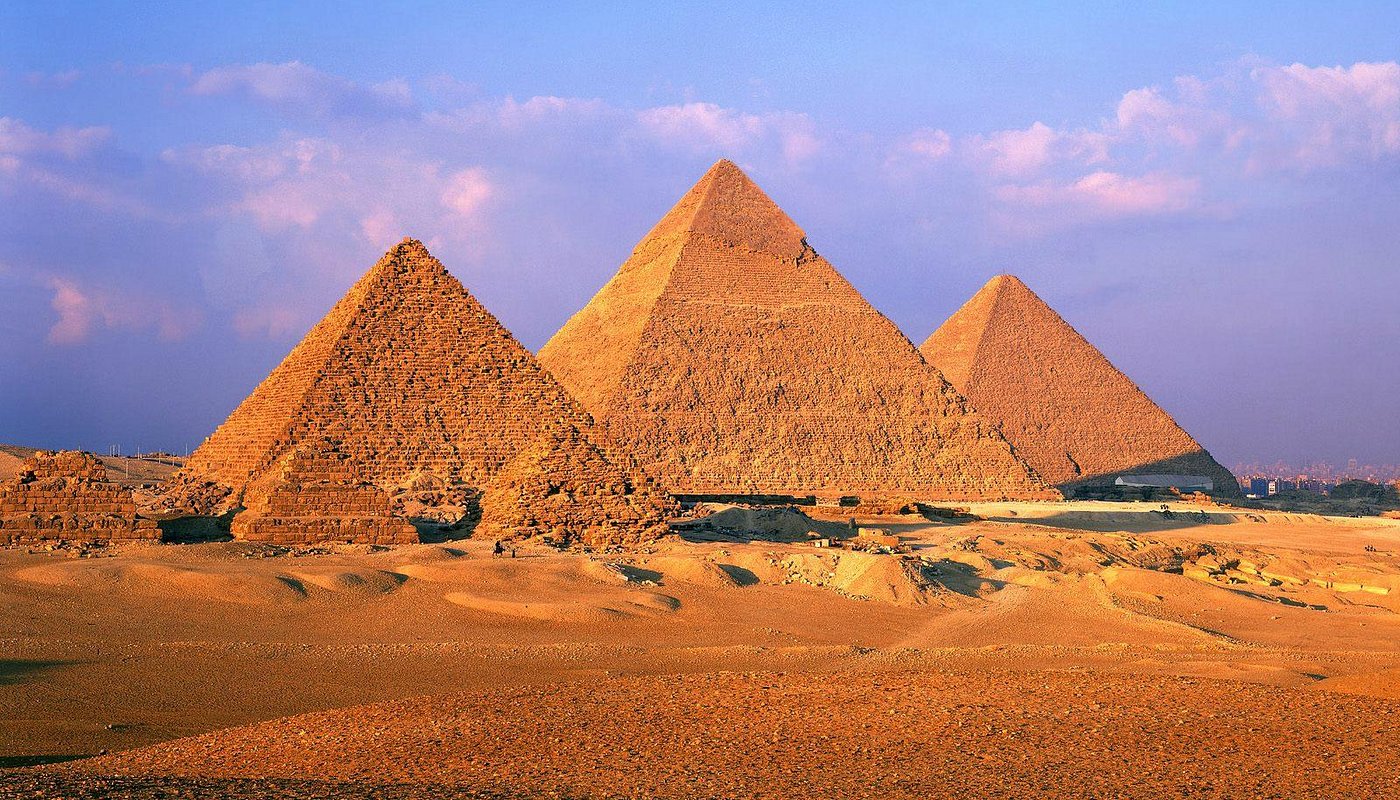
In March 2025, a team of Italian scientists held a press conference in Bologna that should have shaken archaeology to its foundations. Using synthetic aperture radar—military-grade satellite imaging technology—they announced the detection of massive, geometrically precise structures extending over a kilometer beneath Egypt’s Giza Plateau.
Eight months later, four independent satellite operators have confirmed the same readings.
Mainstream archaeology has responded with silence, or dismissal. But the data keeps accumulating. And the man behind the technology has credentials that are difficult to ignore.
The Scientist
Filippo Biondi holds a PhD in signal processing and works at the intersection of academia and defense. His institutional email—smd.difesa.it—places him within the Italian Defense Ministry. His research spans synthetic aperture radar optimization, infrastructure monitoring, and security applications. This isn’t a fringe theorist. This is a radar engineer whose technology is trusted for military and critical infrastructure analysis.
Biondi’s innovation is SAR Doppler Tomography: using satellite radar to detect microscopic surface vibrations caused by background seismic waves. These vibrations carry acoustic “fingerprints” from structures thousands of feet underground. By analyzing how the signals differ over time and space, the technique reconstructs 3D images of what lies beneath.
The method was first applied to the Great Pyramid in 2022, with results published on arXiv and later in the peer-reviewed journal Remote Sensing. But it was the March 2025 press conference—focused on Khafre, the second pyramid—that made headlines.
The Findings
What the team claims to have found beneath the Khafre Pyramid:
Eight hollow cylinders dropping straight down from the pyramid’s base, extending over a kilometer into the bedrock. Two symmetrical sets of four. Vertical shafts descending far deeper than any known Egyptian construction.
A massive chamber at the bottom, roughly 80 meters across. Connected to the cylinders. At a depth that defies conventional explanation.
Geometric precision throughout. Not natural cavities. Not random voids. Structured, uniform, repeating.
If true, this would represent engineering on a scale that contradicts everything we think we know about ancient Egyptian capabilities.
The Verification Problem
Extraordinary claims require extraordinary evidence. Where does Biondi’s evidence stand?
The strongest argument: four independent satellite operators—Umbra, Capella Space, ICEYE, and Italy’s Cosmo-SkyMed—have all returned matching data. These are separate companies, using different satellites, different orbital parameters, different processing pipelines. They don’t share raw data. They compete commercially.
“All four satellites gave exactly the same results,” Biondi stated in his December 2025 interview with Jesse Michels on American Alchemy. “That is really amazing. We cannot announce anything without these basic scientific methods.”
This is not nothing. In signal processing, independent confirmation from multiple sources is the gold standard for ruling out instrumental artifacts. If all four systems show the same structures in the same locations, the probability that this is noise or processing error drops dramatically.
The skeptical response: Egyptologist Zahi Hawass dismissed the findings as “fake news” from “a group of amateurs.” Geophysicists note that SAR is typically used for surface mapping, not deep subsurface imaging. Without peer review, without on-site verification, without Egyptian government cooperation, the claims remain—technically—unproven.
But dismissal is not refutation. And the data exists.
The Technology Question
The debate isn’t really about whether there are structures under Giza. It’s about whether we have the tools to detect them from space.
Biondi’s defenders point out that SAR technology has evolved dramatically. The principle—detecting micro-vibrations caused by seismic waves interacting with underground structures—is sound physics. The same approach monitors dam stability, detects underground tunnels, and tracks infrastructure health. If it works for the Mosul Dam (one of Biondi’s published applications), why not for Giza?
Critics counter that detecting structures at 700+ meters depth is unprecedented. That the interpretation of tomographic data is complex and easily misread. That extraordinary depth claims require on-site seismic surveys to confirm.
Both sides have valid points. The question is whether the critics have addressed the specific evidence—four matching datasets—or merely noted that the evidence is unusual.
The Disclosure Angle
Here’s where the story gets stranger.
Biondi’s work has military applications. His affiliation with the Italian Defense Ministry isn’t a secret—it’s on his institutional email. The technology he developed serves defense and security purposes. This isn’t pseudoscience from the fringe. It’s cutting-edge signal processing from someone trusted with sensitive applications.
Why would such a person stake his professional reputation on claims about pyramid basements?
One answer: he believes the data.
Another answer, increasingly whispered in certain circles: controlled disclosure.
The theory goes like this: governments possess information about anomalous discoveries that would fundamentally alter public understanding of history and technology. Rather than announce such information directly—with all the institutional disruption that implies—they allow it to emerge gradually through academic channels, giving society time to adjust. A military scientist publishing unusual archaeological findings fits this pattern.
There’s no proof of this. It’s speculation built on pattern-matching. But the pattern keeps appearing.
Truth Hidden in Fiction
Which brings us to Jenner Brown’s novel Tesla and the Pyramid.
Published in late 2024, Brown’s technothriller tells the story of Columbia professor Tony Koviak, who teams with a rogue CIA analyst to decode Nikola Tesla’s classified final research—physics that allegedly replicate ancient pyramid technology. The plot weaves together Tesla’s seized papers, secret government projects, and the theory that the pyramids functioned as wireless power transmission systems.
What makes the book notable isn’t the fiction. It’s the claim in the author’s note: “All archaeology, mythology, symbols, locations, organizations, and speculative scalar physics are real and accurate.”
This is the soft disclosure playbook. Outlandish ideas appear first in fiction, where they can be dismissed as imagination. Then credentialed researchers publish data. Then the data accumulates until dismissal becomes harder than engagement.
Whether Brown’s novel is part of any coordinated effort or simply a well-researched thriller riding the zeitgeist is unknowable. But the themes—Tesla’s suppressed technology, ancient advanced civilizations, pyramids as energy systems—map directly onto Biondi’s findings. The convergence is striking.
Readers of Tesla and the Pyramid describe it as “Indiana Jones meets Robert Langdon meets Graham Hancock.” The novel has sparked “much discussion” and motivated independent research. This is what soft disclosure looks like: entertainment that plants seeds.
What Happens Now
The Biondi team is pursuing next steps. They’ve proposed clearing sealed shafts between Khafre and the Sphinx, running direct seismic surveys to ground-truth the satellite data, and—if Egypt authorizes—entering the tunnel system.
Biondi is seeking $20 million in funding and has begun establishing a foundation in Malta. The project, called the CAF Project, aims to bring together radar specialists, archaeologists, and excavation teams.
Whether Egypt will cooperate remains uncertain. Zahi Hawass’s dismissal suggests institutional resistance. But Hawass no longer controls Egyptian antiquities, and international pressure—or simply the weight of accumulating evidence—may shift the calculation.
The alternative is stasis: data that exists but isn’t verified, claims that aren’t refuted but aren’t confirmed, a mystery that persists because no one with authority will look.
The Question That Won’t Go Away
Set aside, for a moment, what you think is possible. Consider only what has been claimed and what would be required to refute it.
Four independent satellite systems have returned matching data showing geometric structures at depth beneath the Khafre Pyramid. The scientist presenting this data has military credentials and peer-reviewed publications. The methodology—SAR Doppler Tomography—is established physics applied at unprecedented depth.
To dismiss this requires one of the following:
- The data from four independent operators is fabricated or manipulated
- The interpretation of matching datasets is fundamentally flawed
- The structures exist but are natural, not engineered
- SAR cannot work at these depths, regardless of what the data shows
Each of these is possible. None has been demonstrated.
What would settle it: direct seismic survey at Giza. Ground-penetrating radar at the surface. Drilling if permitted. Physical verification of what the satellites claim to see.
Until that happens, the signal remains. Four satellites. One Italian scientist. Eight hollow cylinders. A kilometer of depth. And a civilization’s origin story that may need rewriting.
The pyramids have kept secrets for five thousand years. Perhaps they’re not done yet.
Watch the interviews: Joe Rogan #2443 with Filippo Biondi and Jesse Michels’ American Alchemy deep-dive. Biondi’s original research on the Great Pyramid was published in Remote Sensing. Jenner Brown’s novel Tesla and the Pyramid is available on Amazon.