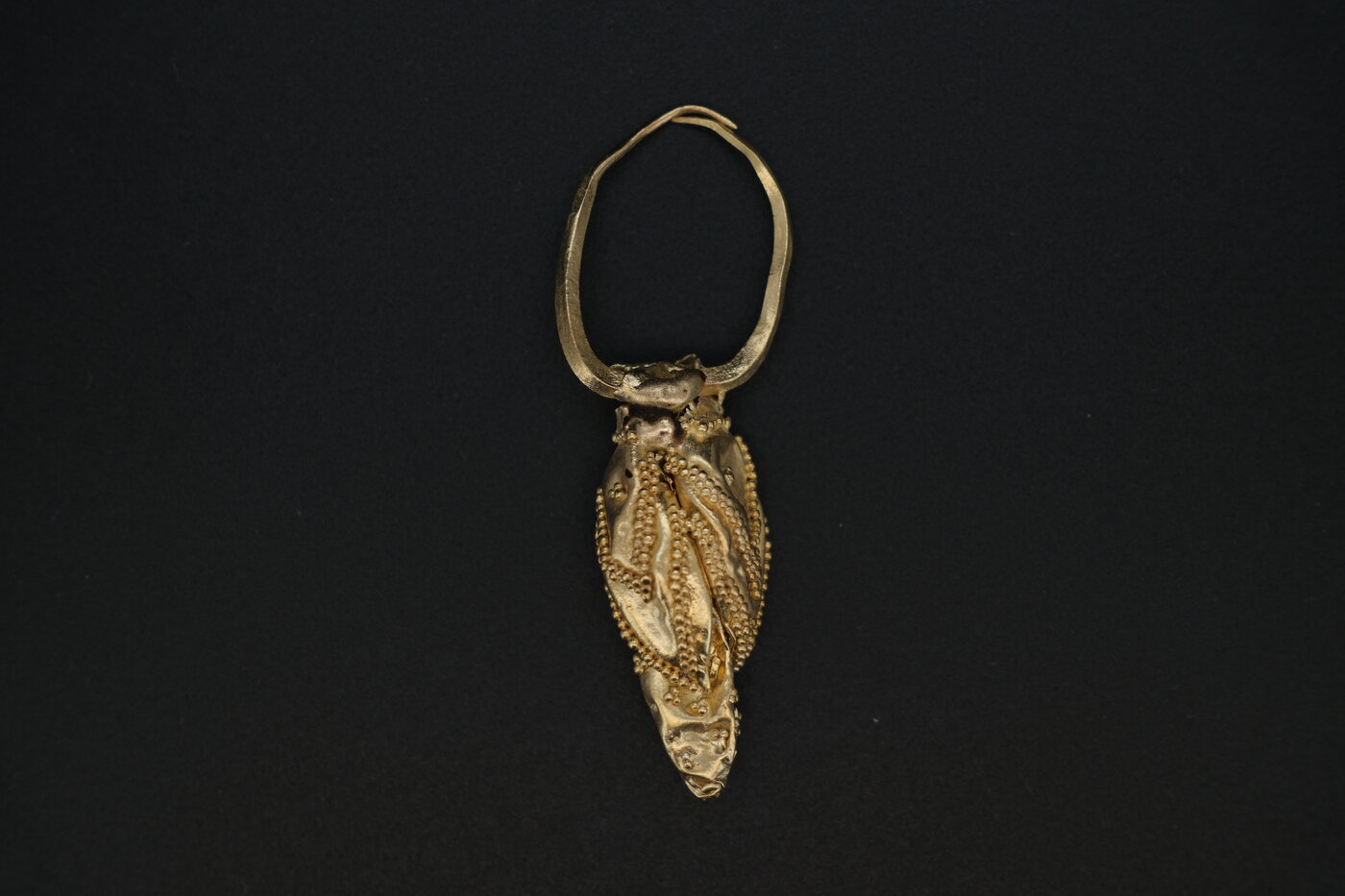
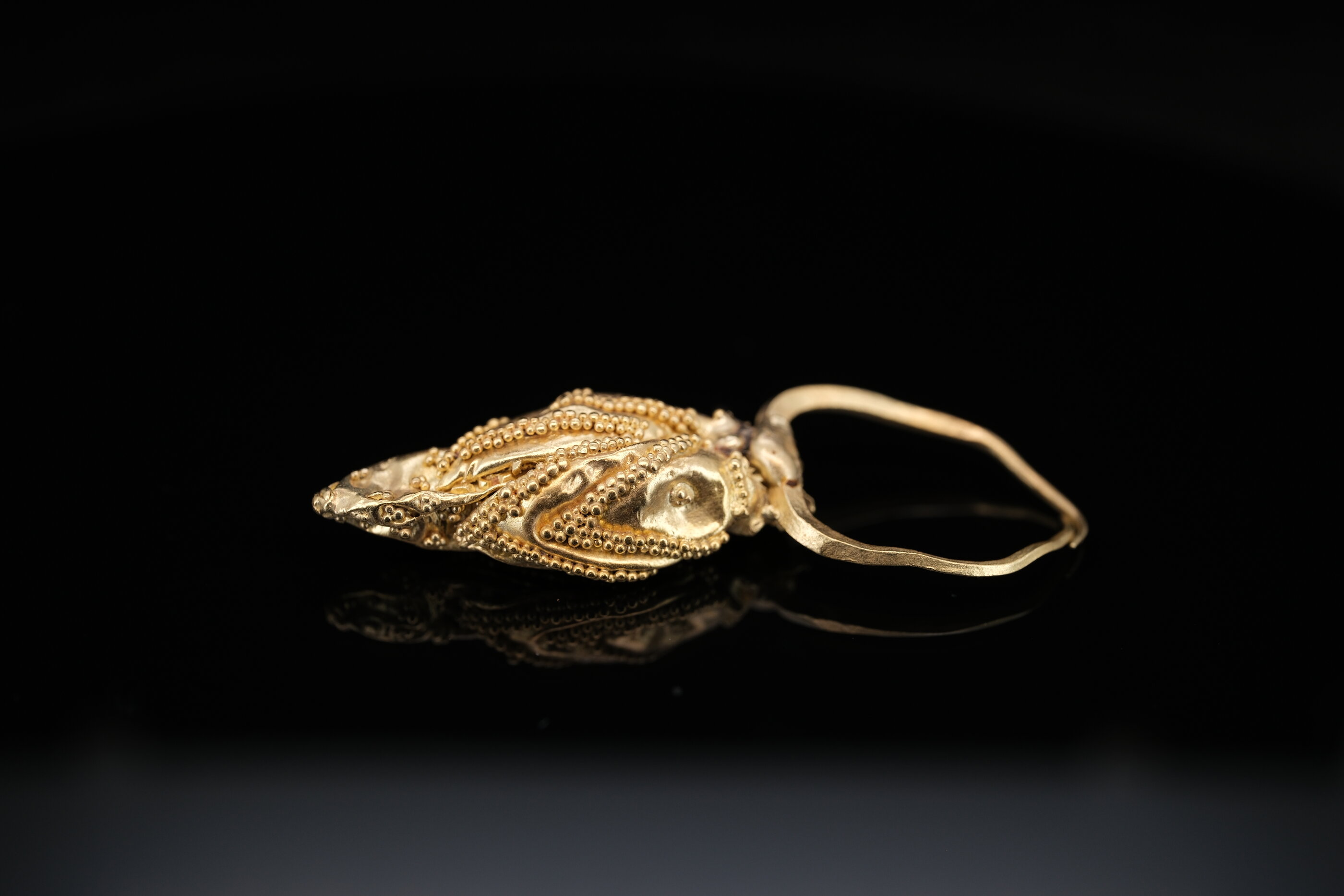
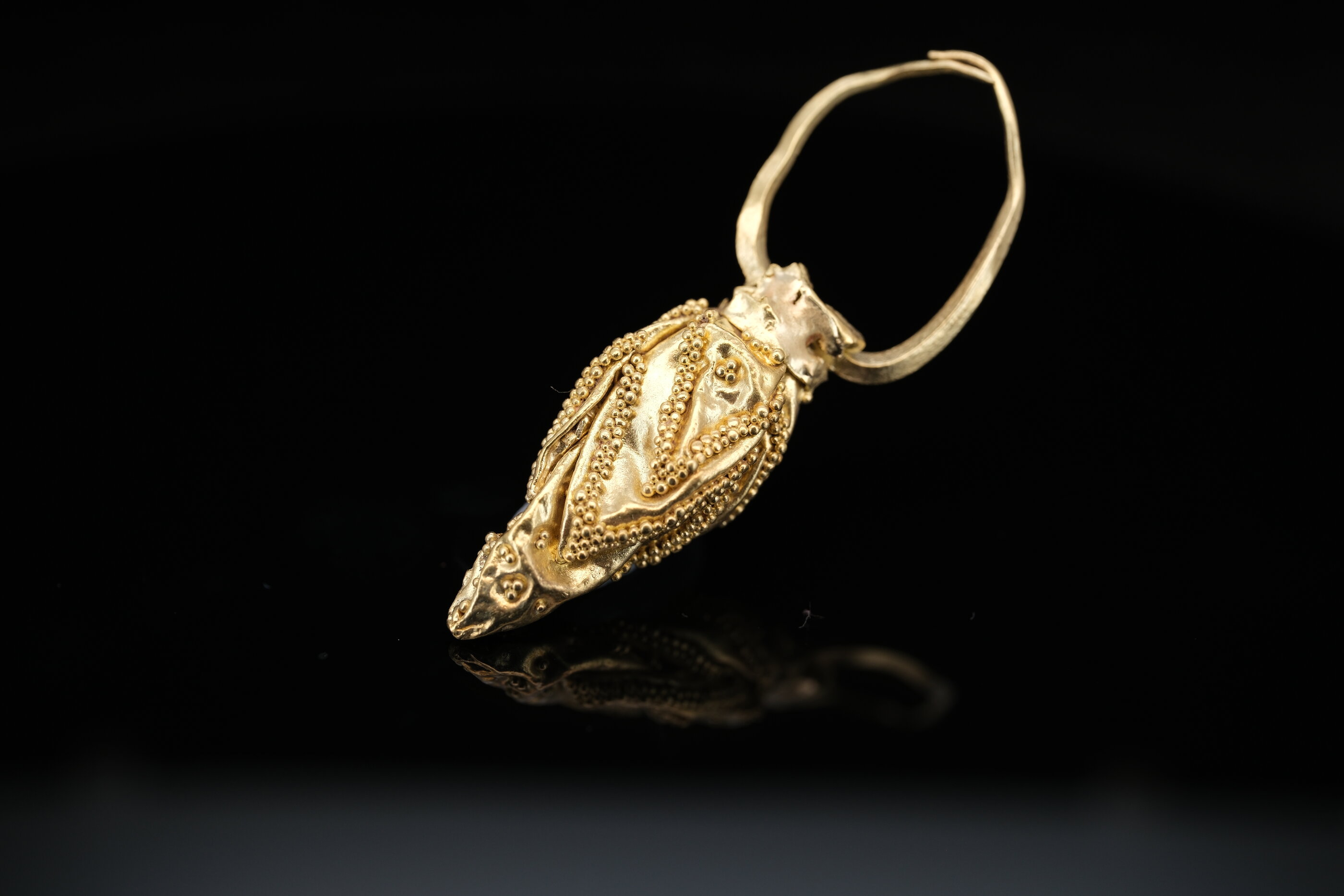
Look closely at a piece of Hellenistic gold jewelry and you’ll see something impossible: thousands of tiny gold spheres, each smaller than a grain of sand, fused to a gold surface with no visible solder, no gap, no seam. The granules simply become the metal beneath them.
For centuries, this baffled historians and metallurgists alike. How did ancient craftsmen achieve molecular-level bonding without modern equipment? The answer, when finally rediscovered in the 1930s, turned out to involve chemistry that the ancients understood intuitively but couldn’t explain.
The Technique
Granulation begins with making the granules themselves. Gold wire is cut into tiny segments and heated until surface tension pulls each piece into a perfect sphere. The smaller the granule, the more difficult every subsequent step becomes.
The Greeks typically worked with granules around 0.25mm in diameter. The Etruscans, who took the technique to its absolute peak, achieved granules as small as 0.14mm—roughly the width of two human hairs.
The Mystery of the Bond
Conventional soldering uses a third metal with a lower melting point to join two pieces. But ancient granulated jewelry shows no solder between granule and surface. Under magnification, the bond appears seamless—as if the granule grew directly from the gold sheet.
Early theories proposed that the ancients had access to some lost alloy or used exotic fluxes. Some suggested the technique was simply superior craftsmanship with conventional solder, applied so precisely it left no trace.
None of these explanations held up.
Chrysakolla: The Gold Glue
The breakthrough came from an unlikely source: the ancient Greek word for malachite. They called it chrysakolla—literally “gold glue” or “gold solder.” This wasn’t poetic license. It was a technical description.
The secret was colloidal soldering, also called eutectic bonding. Here’s how it worked:
- Prepare the adhesive: Mix finely ground copper compounds (malachite, copper oxide from annealing scale, or copper sulfate) with an organic binder like gum tragacanth
- Apply to the surface: Paint this paste where granules will sit
- Position the granules: Using a fine brush (often a single hair), place each granule individually
- Fire in a reducing atmosphere: Heat the piece while controlling oxygen levels
At precisely the right temperature—around 890°C—the copper diffuses into both the granule and the base sheet at their point of contact. This creates a eutectic bond: a molecular joining of the metals at a temperature below their individual melting points.
The gum burns away. The copper becomes invisible, absorbed into the gold. What remains is a perfect metallurgical marriage with no apparent intermediary.
The Styles of Granulation
Ancient goldsmiths developed three distinct approaches:
Outline style: Granules trace the edges of embossed or engraved designs, emphasizing form without obscuring it.
Silhouette style: Figures are entirely covered in granules, creating a textured surface that catches light from every angle.
Reserved silhouette style: The background fills with granules while the main figures remain smooth—a reversal that makes the subject emerge from a shimmering field.
The earring in this collection demonstrates a sophisticated pattern-based approach, with granules arranged in chevrons and curves that create rhythm across the surface.
Why It Matters
The granulation technique reveals something important about ancient craft: it required simultaneous mastery of metallurgy, chemistry, and manual dexterity. The goldsmith needed to understand how metals behave at high temperatures, how copper compounds interact with gold, and how to manipulate objects smaller than the eye can easily resolve.
There were no thermometers. No microscopes. No temperature-controlled kilns. Success depended on observation, experience, and the kind of tacit knowledge that can only be transmitted through apprenticeship.
The Lost and Found
After the fall of Rome, true granulation largely disappeared from European metalwork. Medieval and Renaissance goldsmiths could solder small balls to surfaces, but the invisible, eutectic bond eluded them.
The technique wasn’t conclusively recovered until 1933, when H.A.P. Littledale in London patented a process based on copper salt chemistry—unaware that craftsmen in Etruria had perfected the same method two and a half millennia earlier.
Modern jewelers can now replicate ancient granulation with scientific precision. But holding a genuinely ancient piece—feeling its weight, seeing how light plays across surfaces made before the Roman Empire rose—connects us to individual craftsmen whose names we’ll never know but whose skill speaks across centuries.
That’s what artifacts preserve: not just objects, but evidence of minds solving problems with the materials at hand.