The ring was a prayer you could wear.
Sometime around 200 BCE, a person in the eastern Mediterranean slipped a bronze ring onto their finger. On the bezel: Tyche, goddess of fortune, holding a cornucopia overflowing with abundance and a grain stalk promising harvest. Every glance at their hand was a small petition. Let luck favor me. Let chance break my way.
We don’t know who wore this ring. We don’t know if their prayers were answered. We know only that they lived in an age when fortune had become the most important force in the universe—and the most terrifying.
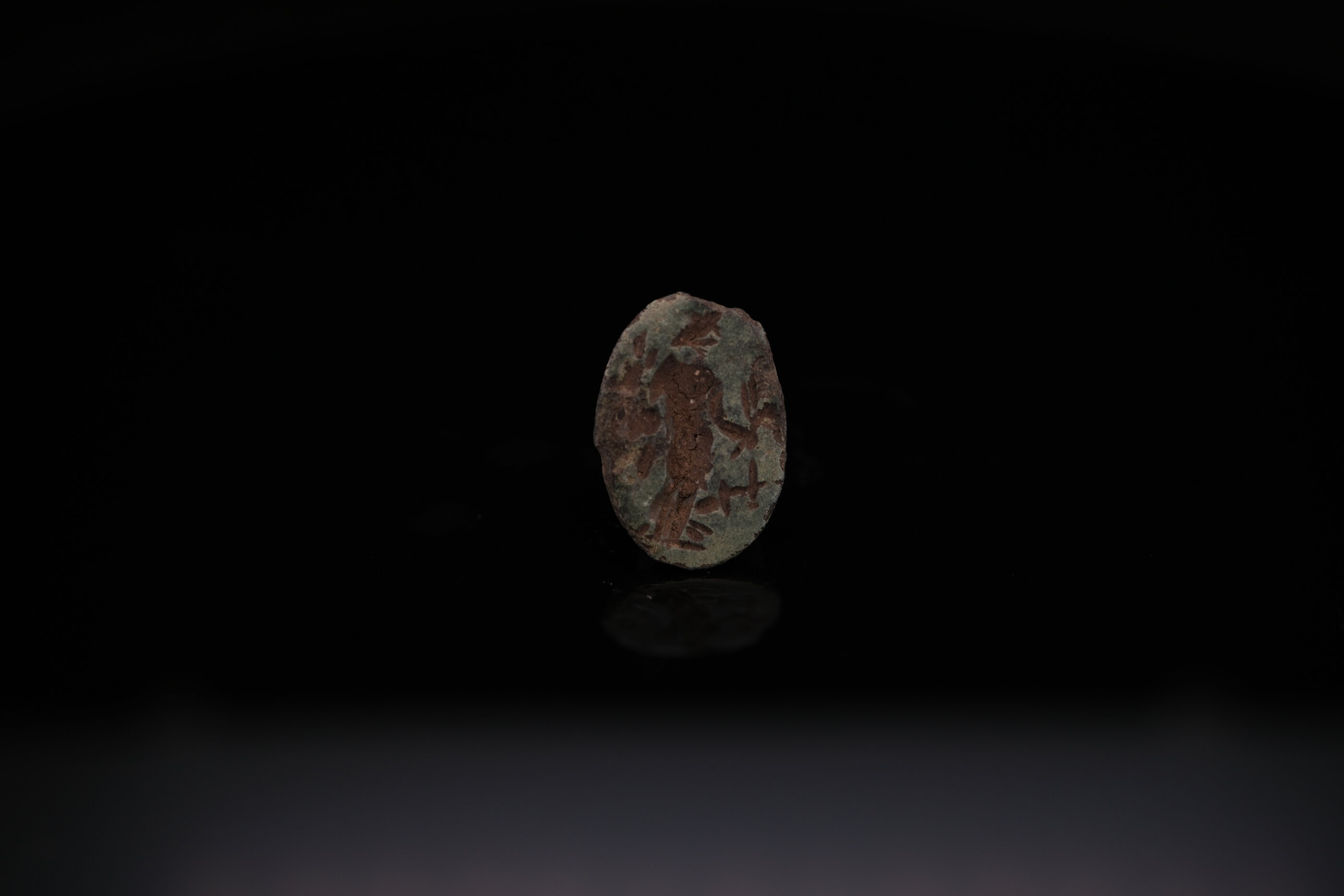
When the World Stopped Making Sense
For centuries, Greeks had lived in small city-states where a citizen might know their rulers, influence their politics, predict their future within reasonable bounds. Life was local. Causation was visible. If your city prospered, you could point to wise leaders, good harvests, favorable trade. If it suffered, you could identify the failures.
Then Alexander happened.
In thirteen years, a Macedonian king conquered everything from Greece to India. When he died in 323 BCE, aged thirty-two, his generals carved his empire into warring kingdoms. Cities that had stood for centuries were founded and destroyed in decades. A merchant might go to sleep a subject of one king and wake up a subject of another. Entire populations were relocated on royal whim.
The Hellenistic world that emerged was vast, unstable, and incomprehensible. Individual action seemed disconnected from individual outcome. You could do everything right and still be destroyed by distant wars, economic shifts, or plagues that swept across continents. The old gods—Zeus, Athena, Apollo—still received worship. But they seemed suited to a smaller world, a world where causes and effects were traceable.
What the new world needed was a goddess of pure, ungovernable chance.
The Rise of Tyche
Tyche wasn’t new. She appears in early Greek poetry as a minor figure, one of the Oceanids, a sea-nymph of no particular importance. Pindar mentions her in the 5th century BCE as a daughter of Zeus who steers the fates of ships and cities. But she was a background deity, rarely worshipped directly.
The Hellenistic period transformed her into one of the most important gods in the Mediterranean.
Cities began adopting Tyche as their patron deity. The Tyche of Antioch, sculpted around 300 BCE, became one of the most copied statues in the ancient world—a seated goddess wearing a crown shaped like city walls, one foot resting on a swimming figure representing the Orontes River. Every major Hellenistic city wanted its own Tyche, its own personification of civic fortune.
But Tyche was also deeply personal. Rings like the one in our collection were private devotions. Tyche appeared on coins, gems, amulets, household shrines. People didn’t just acknowledge fortune—they courted her, bribed her, begged her.
The historian Polybius, writing in the 2nd century BCE, complained that his contemporaries attributed everything to Tyche. Won a battle? Tyche. Lost a fortune? Tyche. Good harvest, bad marriage, successful voyage, sudden death—all Tyche. It was, he grumbled, intellectual laziness, a refusal to analyze actual causes.
But was it? Or was it something more honest?
The Philosophers’ Problem
The rise of Tyche forced ancient philosophers to confront a question they’d largely avoided: what role does pure chance play in human life?
The answers split along predictable lines—and revealed something about the psychology of each school.
The Stoics denied chance entirely. The universe, they argued, was governed by logos—divine reason, an unbroken chain of cause and effect. What looked like randomness was simply causation too complex to trace. Tyche was an illusion, a name ignorant people gave to causes they couldn’t identify. The wise person understood that everything happened according to fate, and therefore nothing was truly surprising or unjust.
This was philosophically elegant. It was also, for most people, emotionally unbearable. If everything is fated, then suffering is predetermined. Your child’s death, your city’s destruction, your own misfortune—all scripted from eternity. The Stoic answer to this was acceptance: amor fati, love of fate. But acceptance is a discipline that most humans, most of the time, cannot sustain.
The Epicureans took the opposite position. The universe was composed of atoms falling through void, occasionally swerving at random. Chance was real, baked into the fabric of reality at the most fundamental level. The gods existed but didn’t intervene—they lived in perfect tranquility, unconcerned with human affairs. Fortune was neither divine nor meaningful. It was simply what happened when atoms bounced unpredictably.
This preserved human freedom (the random swerve broke determinism) but at the cost of cosmic meaning. There was no one to thank for good luck, no one to blame for bad. The Epicurean answer was withdrawal: cultivate your garden, enjoy simple pleasures, stop hoping the universe cares about you.
The Skeptics suspended judgment. Maybe chance was real, maybe it wasn’t—how could we know? The appropriate response was ataraxia, tranquility through non-commitment. Don’t invest emotionally in any metaphysical claim. Things happen. Respond as needed. Don’t build elaborate theories that will only cause suffering when they fail.
Notice what’s happening here: the philosophical schools are as much psychological temperaments as intellectual positions. The Stoic craves order and is willing to pay for it with acceptance of suffering. The Epicurean craves freedom and is willing to pay for it with cosmic loneliness. The Skeptic craves peace and is willing to pay for it with perpetual uncertainty.
And the common person, wearing a Tyche ring? They wanted something simpler: hope that fortune might be influenced. A universe where luck was real but not entirely indifferent. Where a prayer might help.
The Honest Superstition
Here’s the uncomfortable truth the philosophers didn’t want to admit: the Tyche worshipper might have been the most honest of all.
Consider what we now know about probability and human cognition. Randomness is real—quantum mechanics confirms it. But randomness doesn’t distribute evenly across human timescales. Lucky streaks happen. Unlucky streaks happen. Regression to the mean is true statistically but irrelevant experientially: your life is a single sample, not an infinite series.
The Stoic position—that apparent randomness is just hidden causation—has been undermined by physics. There are genuinely stochastic processes. The universe does roll dice.
The Epicurean position—that chance is real but meaningless—may be technically correct but is psychologically untenable. Humans are pattern-seeking creatures. We will find meaning even where there is none. Telling people to stop isn’t philosophy; it’s denial of human nature.
The Skeptic position—suspend judgment—works for abstract questions but fails for practical ones. You have to make decisions. You have to act as though some things are more likely than others.
What about the ring-wearer? Their position was something like: I don’t know if fortune listens, but it costs me little to ask, and the asking itself brings comfort.
This is not sophisticated philosophy. It might be something better: an adaptive response to irreducible uncertainty.
Fortune’s Attributes
The iconography of Tyche tells us how the ancients understood fortune’s nature.
The cornucopia: abundance pours from fortune’s horn. Not wages for work, but windfalls. Unexpected inheritances, chance discoveries, gifts from nowhere. Fortune gives without your earning it.
The rudder: fortune steers. You can row, but she determines direction. Your effort matters, but it doesn’t determine outcomes. The same voyage, the same skill, might end in profit or shipwreck depending on winds you can’t control.
The wheel: fortune turns. What goes up comes down. Today’s king is tomorrow’s beggar. The wheel’s message is that no condition is stable. Even good luck is temporary.
The ball: fortune stands on a sphere, always about to roll away. You cannot grasp her. The moment you think you have her, she’s gone.
The blindfold (in later depictions): fortune doesn’t see who she favors. Merit is irrelevant. This was the most disturbing attribute—the suggestion that good people suffer and bad people prosper not as punishment or test, but simply because fortune doesn’t look.
These symbols encode a sophisticated understanding of randomness. Fortune is generative (cornucopia), directional (rudder), cyclical (wheel), unstable (ball), and arbitrary (blindfold). That’s not a bad folk theory of probability.
The Gambler’s Fallacy and Its Opposite
Modern psychology has identified two opposite errors in thinking about chance:
The gambler’s fallacy: believing that random events must “balance out” in the short term. If the coin came up heads five times, tails is “due.” This is false. The coin has no memory.
The hot hand fallacy: believing that success predicts success, that someone “on a roll” is more likely to continue succeeding. For truly random events, this is also false.
But here’s the thing: for many real-world events, the hot hand is real. Success breeds confidence, confidence improves performance, better performance brings more success. Human affairs aren’t coin flips. They’re entangled systems where outcomes influence future probabilities.
The ancients understood this intuitively. Tyche wasn’t purely random—she could be courted, offended, propitiated. She had favorites. She bore grudges. This anthropomorphization of chance wasn’t primitive thinking. It was a recognition that luck in human life isn’t purely stochastic. Your fortune does depend, somewhat, on how you treat fortune.
Or as a modern might put it: opportunity favors the prepared, but preparation doesn’t guarantee opportunity. Both sides of that sentence are true.
Why We Still Wear Lucky Charms
Two thousand years later, Tyche’s temples are ruins. Her cult is extinct. And yet:
Athletes have lucky socks. Gamblers have lucky seats. Students have lucky pens. Business executives knock on wood. Rational materialists “don’t really believe” but still feel weird walking under ladders.
Why?
The standard explanation is that we’re running outdated cognitive software. Our brains evolved in environments where pattern-detection was crucial for survival, and we over-apply it. Lucky charms are glitches, misfires, errors.
But consider an alternative: lucky charms are useful errors.
When you wear your lucky ring, you feel slightly more confident. Confidence affects performance. Better performance improves outcomes. The ring didn’t magically cause success—but the belief in the ring caused a psychological state that contributed to success.
This is not supernatural. It’s psychosomatic in the most literal sense: mind affecting body, affecting world. The Tyche worshipper, touching their ring before a negotiation, was giving themselves a micro-dose of confidence. The ritual was the active ingredient.
Superstition, in this light, isn’t the failure to understand probability. It’s the success of understanding psychology.
Fortune and Justice
The deepest problem Tyche posed was moral.
If fortune governs outcomes, what happens to justice? The good person struck by lightning, the tyrant who dies peacefully in bed—these aren’t anomalies under Tyche’s rule. They’re the norm. Fortune doesn’t weigh merit.
This was intolerable to many ancient thinkers. Plato argued that apparent injustice was corrected after death—the wicked punished, the virtuous rewarded. The Stoics argued that external fortune didn’t matter—only virtue, which fortune couldn’t touch. The Epicureans argued that we should stop expecting cosmic justice and find contentment in simple pleasures.
But the Tyche worshipper had a different answer: try to win her favor.
This seems crude—bribing the goddess. But think about what it implies. If fortune can be influenced, then you’re not purely passive. You can light incense, make offerings, wear the ring, perform the rituals. You have agency, even if that agency operates through petition rather than direct control.
Compare this to the Stoic position: accept whatever fate decrees. Which feels more empowering? The Stoic achieves peace by relinquishing hope of influence. The Tyche worshipper maintains hope of influence at the cost of constant uncertainty.
Neither is wrong. They’re different strategies for the same impossible situation: being a finite creature in an ungovernable world.
The Goddess Who Won
In the long competition of ancient philosophies, who won?
Not the Stoics—few people actually live as though nothing external matters. Not the Epicureans—withdrawal from ambition is a minority taste. Not the Skeptics—humans cannot help believing things.
In practice, most people then and now live like Tyche worshippers. We believe that luck is real, that it can shift, that somehow—through virtue, ritual, positive thinking, or sheer persistence—we might influence it. We know this is irrational. We do it anyway.
This isn’t failure. It’s adaptation. Pure rationality about probability would be paralyzing. If you truly internalized that your efforts have only partial influence on outcomes, that the same actions can produce wildly different results, that life is a sample size of one from an infinite distribution of possibilities—you might never get out of bed.
The Tyche ring is a small irrationality that enables large functionality. By externalizing luck as a goddess who might be pleased, you transform helplessness into petition. By wearing her image, you remind yourself that fortune exists—and that you haven’t given up on catching her attention.
Two millennia later, we’ve replaced Tyche with probability theory. We understand randomness better than any ancient philosopher. And we still knock on wood.
The goddess won. She just changed her name.
The bronze Tyche ring bezel dates to approximately 200-100 BCE. The ring band has been lost to time—fortune, as ever, takes what she gives. See our collection for more objects from the Hellenistic world.